A marketing breakdown by Ashley Brasseaux — fractional CMO to mission-driven founders, with $5M+ in client campaign revenue.
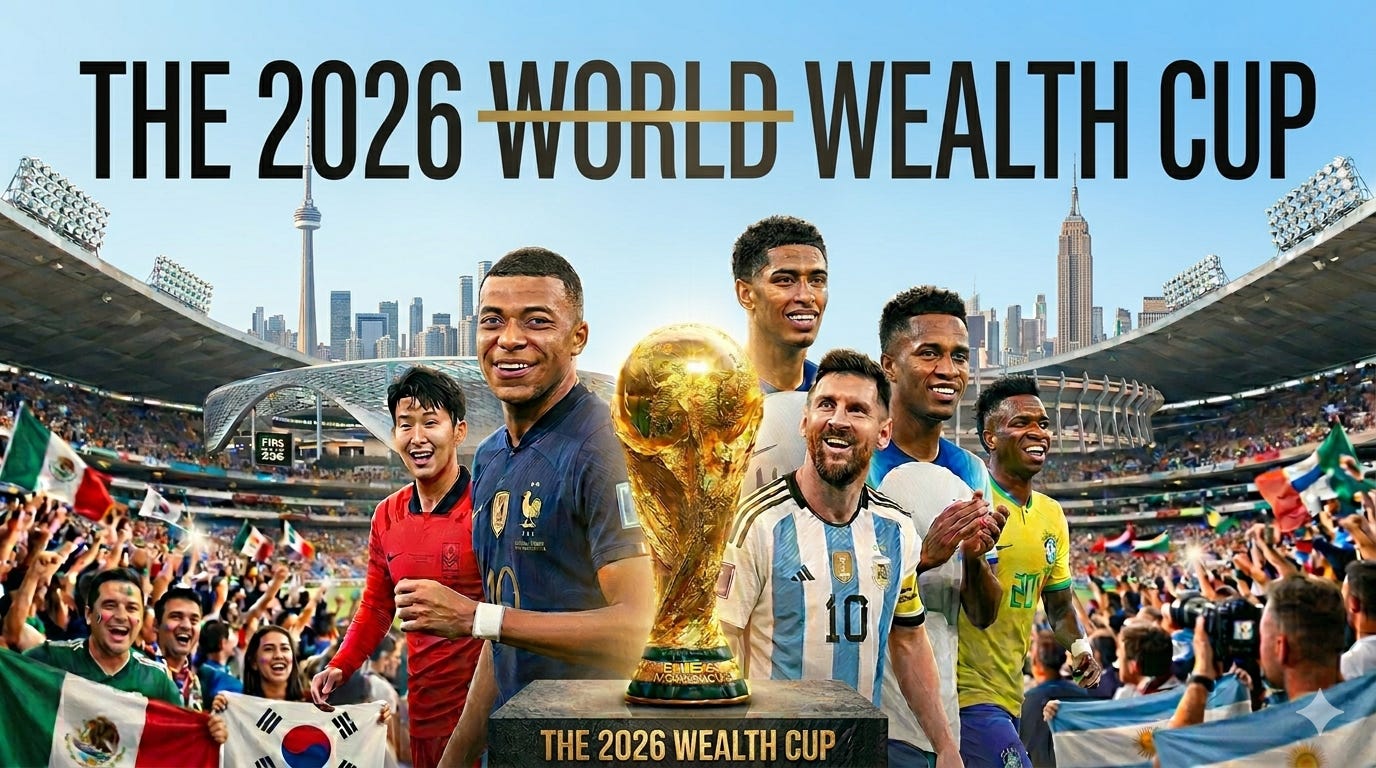
The 2026 World Cup kicks off in three days and only the top 1% can afford to go.
For the first time in the men's World Cup's entire history, FIFA is using dynamic pricing — the real-time, supply-and-demand, the-price-changes-every-time-you-refresh-the-page model.
They are treating the World Cup like a Taylor Swift concert, and what that means in practice is that ticket prices are no longer being set by an institution trying to balance access against revenue. They are being set by 500 million ticket requests competing for 7.1 million available seats, with an algorithm doing exactly what algorithms do when scarcity meets demand at that scale.
This is supposed to be the World Cup — the most global sporting event on the planet, and yet here we are, three days from the opening match, and most of the globe has been priced out.
This is a deliberate choice that has FIFA projecting to pull in around $15 billion this World Cup cycle — a number that was never possible under the old lottery-based pricing model they used in every tournament before this.
The old model existed to protect access (tickets were set 12 to 18 months in advance at fixed tiers, and Category 4 was reserved specifically for residents of the host country so locals couldn't be priced out).
The new model exists to extract every dollar the market is willing to pay, and the market — as it turns out — is willing to pay a lot.
So what about the other 99%?
My 8-year-old son Liam, is fully convinced he is going to be a professional soccer player one day. He plays three nights a week with the neighborhood kids, wears his favorite team's jersey to school, and has been hoarding every spare peso for his FIFA World Cup sticker album — the kind where you peel and stick the individual player cards, and the whole goal is to fill the entire book before the tournament ends. He is the actual target audience for the sport, the kid every soccer federation in the world claims they want to grow the game for.
I looked up what it would cost to take him to one match, something I thought he would lose his mind over, and was surprised to find that nosebleed seats started at $2,000 USD. That price was for a single seat with the worst view in the stadium, before parking or food or jerseys or any of the actual experience that a kid like Liam would remember for the rest of his life.
This is where the rest of FIFA's marketing strategy comes in, and it is the part almost nobody is paying enough attention to. While the stadium experience is being engineered to squeeze the wealthiest 1% of fans for every dollar they will pay, FIFA has also been building an entirely free version of the World Cup happening in every host city at the same time, on the same days, in some of the most iconic public spaces in North America.
The premium product and the free product were designed in tandem, launched in tandem, and are running side by side for the next 39 days. And here is how the combination of those two products is about to make 2026 the most-watched (and most lucrative) World Cup of all time.
What is the FIFA Fan Festival 2026?
Every single one of the 16 host cities is also running what FIFA is calling a Fan Festival — free entry, all 104 matches of the tournament broadcast live on massive screens, 39 straight days of programming from June 11 through July 19. In Philadelphia, it's at Lemon Hill in East Fairmount Park, the city's central green space where families already gather for the 4th of July. In Atlanta, it's at Centennial Olympic Park, the legacy site from the 1996 Olympics. In New York and New Jersey, the events are spread across all five boroughs so the whole region can participate.
These are not parking lots or sports bars or some forgettable corner of a stadium — these are the most iconic civic public spaces in every host city, the places where you take your kids on the Fourth of July, where the city already gathers for free concerts, where decades of memory are already associated.
What is happening at the fan fests is essentially a 39-day state fair built around soccer. Live broadcasts of every match on giant screens, live music on non-match days, international food vendors representing the nations playing that week, kids zones with soccer skill stations, photo moments with the mascots (Maple the Moose for Canada, Zayu the Jaguar for Mexico, Clutch the Bald Eagle for the U.S.), brand activations, and celebrity ambassadors making appearances throughout the tournament.
The whole thing is free, family-friendly, and built for the exact demographic that the actual stadium tickets are pricing out — moms, kids, grandparents, the casual fan who would never have bought a ticket but might come to a free thing in their favorite park on a Saturday.
How FIFA gave every host city its own brand
FIFA also gave each of the 16 cities their own host brand under a campaign called "Your City. Your Colors." Every city has its own logo, color palette, and creative identity that lives inside the larger "We Are 26" tournament brand, and every city has its own roster of community ambassadors who are unmistakably of that place. Los Angeles has Will Ferrell, Snoop Dogg, Magic Johnson, Luka Doncic, Mia Hamm, Julie Foudy, Eva Longoria, and Cobi Jones — a deliberate map of LA's cultural communities, from Hollywood to Black LA to Latina LA to current and retired NBA to women's soccer history to U.S. soccer history.
Atlanta picked Killer Mike — instead of Ludacris or Usher or any of the obvious sports figures — because Killer Mike is deeply embedded in Atlanta community organizing and Black cultural leadership, and his presence at Centennial Park communicates exactly who the fan fest was built for.
Those ambassadors have a job that has almost nothing to do with selling tickets, because tickets aren't really the product on the table for the audience they are talking to. Their job is to legitimize the fan fest as a space where the local community belongs, where families belong, where the kid who can't afford a stadium seat still gets the message that this event — this enormous global moment — was built with them in mind too. When Killer Mike walks through Centennial Park to watch a match on a giant screen with 30,000 people, the message he's carrying is essentially "this is your event, you belong here, and whatever the stadium is doing for the people who could pay, the version that matters is the one happening right here."
Which brings me to the actual marketing play.
What is FIFA's premium-and-free marketing strategy?
What FIFA has actually done — and this is the part that makes me both annoyed and impressed — is build two completely different products at the same time. The premium product is the stadium experience, which has been engineered to serve only the wealthiest 1% of their potential audience, squeeze that group for every dollar they're willing to pay, and clear roughly $15 billion in the process.
The free product is everything else — the fan fests, the host city ambassadors, the experiential activations, the parks and plazas full of families and high schoolers and grandparents on a Saturday morning watching soccer on a giant screen — all of it designed so that the people who cannot afford to be in the stadium still get to participate, still get to feel like they were there, still walk away with a memory that turns them and their kids into fans for the next 20 years.
The premium product is priced to extract. The free product is built to expand.
The revenue from the first one funds the cultural infrastructure of the second one, and the cultural infrastructure of the second one builds the next two decades of demand for the first one. You cannot run that play with only one of the two products, because a premium-only strategy gets you a tournament that nobody remembers, and a free-only strategy bankrupts you. Run both side by side, designed in tandem, with deliberately different jobs, and what you get is a generational cultural moment that also happens to make you $15 billion.
And here is why I think it's genius, even though I hate it.
Why FIFA has to rebuild the World Cup brand every four years
FIFA has a problem that no other major sports brand has — the World Cup happens once every four years, which means they go dark for 47 months out of 48. The NFL gets to compound brand equity 52 weeks a year, the NBA does the same, and every other major sport gets to stay present in the culture continuously.
FIFA gets one summer every four years, and every cycle they are essentially relaunching the product from scratch. That is why the infrastructure of this 2026 campaign — the fan fests, the host city brands, the ambassadors, the mascots, the merch partnerships — matter so much more than any single ad they could have bought. Their goal goes well beyond manufacturing six weeks of attention, because they are building physical and social architecture in 16 cities that will still be standing in people's memories long after the trophy goes home.
Fifa knew they couldn’t execute on world building from scratch, or create their own community in 39 days, so they are renting it from every local community where a match is being hosted.
How FIFA is manufacturing a multi-decade cultural moment
The part of all of this that nobody’s really talking about is that FIFA is using this summer to manufacture a multi-decade cultural moment, one that will shape what the World Cup means to the next generation of fans.
Liam, is going to live this summer through giant-screen broadcasts, neighborhood watch parties, and weekend afternoons spent re-enacting goals he watched. He is going to associate the World Cup with family, with home, with summer, with the moments that turn into the kind of memories you build a personality around.
And in 20 years, when Liam is 28 and someone offers him the chance to take his own son to a stadium for the next tournament at $2,500 a ticket, he will pay it without flinching, because by then the World Cup will have become aspirational to him in a way that goes far beyond watching soccer. It will be the thing he always wanted to do, the rite of passage he is finally able to give his own kid, the version of his childhood he is handing forward.
And I know this is how it works because as an 18 year old American who had never once watched a soccer match until spending the summer abroad in Spain in 2010 (the same year that Spain won the World Cup) I have watched the World Cup ever since.
I remember the excitement and energy of the neighbors coming together, painting our faces in patriotic colors, and screaming at the television every time our team made a goal with such fondness that now I make my family watch it with me every 4 years (and I’m Googling ticket prices to the game because I aspire to take my son to see a match in real life).
This is how FIFA will solve the "goes dark for 47 months" problem at its root. By using this summer to engineer a cultural moment, they get to stop manufacturing hype from scratch every four years and start building on what they already have. The free product seeds the next generation of premium buyers. The premium revenue funds the free experience that keeps the pipeline alive. And every cycle, the cultural footprint compounds, the aspiration compounds, and the willingness to pay $2,500 for a ticket 20 years from now compounds with it.
Which means the kids touching the World Cup for the first time this summer at a fan fest in Lemon Hill or Centennial Park are the FIFA revenue projection of 2046.
Despite the fact that fewer people can afford tickets, the 2026 World Cup is going to be the most watched in history because the people who can't afford tickets are still going to touch the tournament in a way no previous generation of fans ever could.
Where I land: why this is the smartest marketing play in FIFA history
I think the dynamic pricing model is going to set a precedent that I'd rather not see become the global default for every major sporting event, because once America normalizes this model FIFA never goes back to the old one, and every UEFA Euro and Copa America and Olympics is watching closely.
And, at the same time, I think the premium-and-free strategy FIFA is running is the most sophisticated marketing move from a business stand point, and the lesson buried inside of it is one that every founder needs to absorb.
The brands that are compounding right now are the ones who figured out that the premium product funds the cultural infrastructure, and the cultural infrastructure builds the next decade of premium buyers.
Most founders only build one of the two, which is why they either burn out trying to sell premium without the culture (or sufficient leads) behind it, or they burn out giving everything away for free without the revenue to sustain it.
An example of someone who’s executed this same strategy exceptionally well in the online space is Alex Hormozi.
You can’t work with Alex until you’ve verifiably made $1 million in your business. For everyone else, there’s his free content. His premium pricing at the top, funds the media and production team that grows the bottom, and he keeps his pipeline full of new premium buyers with the reach, impact, and brand awareness his free content generates.
So the question worth sitting with is: What is your fan fest? What is the free experience you can give away, in the most central space possible, hosted by the most trusted faces in your community, that turns your premium product from extraction into investment in an audience that will still be talking about you in 20 years?
For better or worse, the most lucrative World Cup ever will be experienced by most of the world for free.
To marketing strategies that create cultural moments,
Ashley
P.S. I'll be watching this entire tournament with my CMO brain on, and I want to break down the brand activations as they unfold — the Lay's WhatsApp celebrity rooms, the Home Depot DIY fan zones, the Michelob Superior Player of the Match trophy, the way each host city's brand actually plays out in real life. If you want me to do a follow-up piece on the activations that slayed (and the ones that flopped), reply and let me know. Happy to take you behind the scenes as it all goes live.
If you are interested in working together on your marketing strategy, click here.
TL;DR:
FIFA is using dynamic pricing for the first time at the 2026 FIFA World Cup, pushing tickets to $1,000–$2,500 and projecting $15 billion in revenue. To balance the extraction, FIFA simultaneously built free FIFA Fan Festivals in all 16 host cities, running June 11 through July 19, 2026 — a premium-and-free marketing strategy engineered to make 2026 the most-watched World Cup in history.
Frequently asked questions about the 2026 FIFA World Cup
Why are 2026 FIFA World Cup tickets so expensive? For the first time in the men's World Cup's 96-year history, FIFA is using dynamic pricing, which means ticket prices change in real time based on demand. Combined with over 500 million ticket requests competing for 7.1 million available seats, this has pushed Category 3 (lowest tier) tickets above $1,000 for most matches and final match tickets above $2 million on resale.
What is the FIFA Fan Festival 2026? The FIFA Fan Festival is a free public event being held in all 16 host cities across the United States, Canada, and Mexico from June 11 through July 19, 2026. Each festival broadcasts every World Cup match live on giant screens and includes live music, international food, kids zones, brand activations, and celebrity ambassador appearances.
Is the FIFA Fan Festival free? Yes, entry to all FIFA Fan Festivals is free and open to the public, though some host cities require advance registration.
Where will the FIFA Fan Festivals be held? Each host city is using one of its most iconic public spaces. Philadelphia is at Lemon Hill in East Fairmount Park, Atlanta is at Centennial Olympic Park, Boston is at City Hall Plaza, Dallas is at Fair Park, Vancouver is at the PNE grounds in Hastings Park, and New York/New Jersey is hosting events across all five boroughs.
Who are the 2026 FIFA World Cup mascots? Maple the Moose represents Canada, Zayu the Jaguar represents Mexico, and Clutch the Bald Eagle represents the United States. All three will be featured at the FIFA Fan Festivals and in the upcoming FIFA Heroes video game.
How much revenue is FIFA projected to make from the 2026 World Cup? FIFA is projected to pull in approximately $15 billion this World Cup cycle, in large part due to the new dynamic pricing model and the expansion to 48 teams across 104 matches.
When does the 2026 FIFA World Cup start? The 2026 FIFA World Cup kicks off on June 11, 2026, with the opening match in Mexico City, and runs through July 19, 2026, across 16 host cities in the United States, Canada, and Mexico.