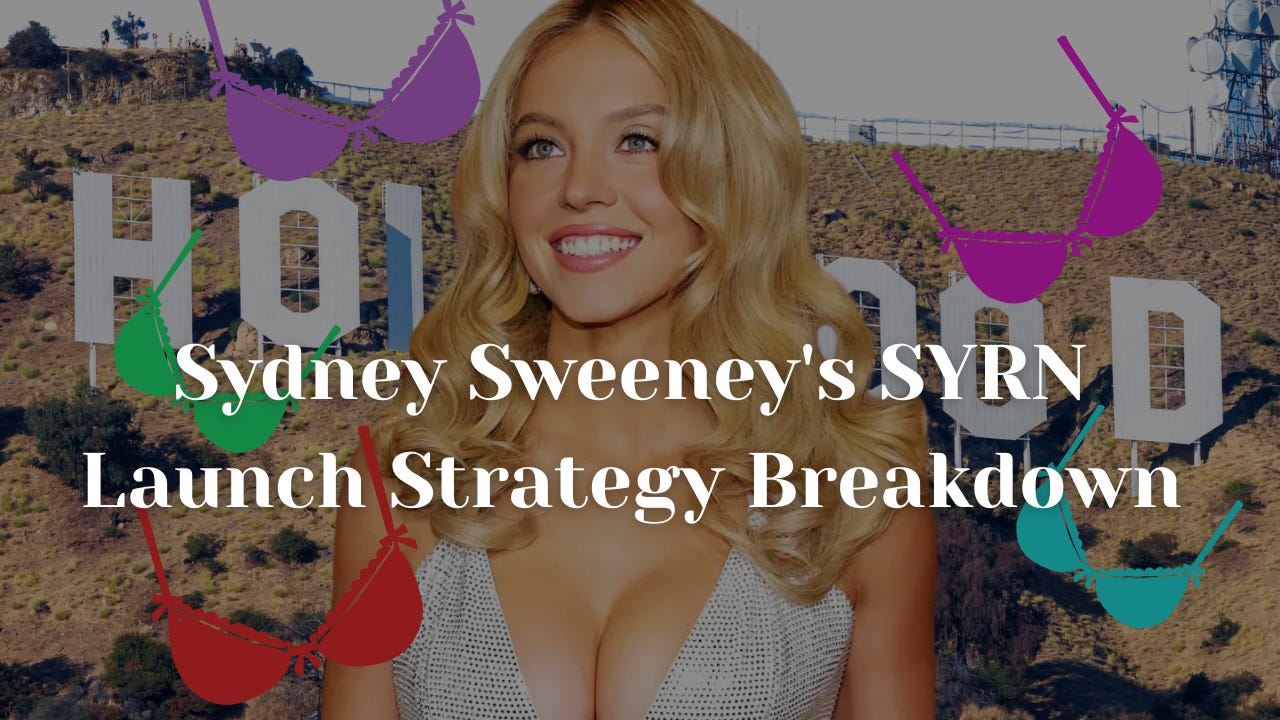
Sydney Sweeney — the 28-year-old actress you probably recognize from Euphoria, The White Lotus, or her most recent film The Housemaid — just climbed the Hollywood Sign in the middle of the night, hung bras and lingerie from every letter, and then filmed herself doing the entire thing.
And somehow, that stunt became one of the most brilliant product launches I’ve seen this year.
If you missed it, here’s what happened: On a Sunday night in late January, Sweeney dressed in black, loaded duffel bags into a van, grabbed her camera crew and her dog, and drove up dark winding roads into the Hollywood Hills to pull off what can only be described as a lingerie heist on one of the most recognizable landmarks in the world.
She hiked up to the sign, scaled the letters, and draped a clothesline of bras across them while her team captured every second of it on camera.
And then her team sent the footage to TMZ.
(Okay — TMZ says they “obtained” the footage, which is standard celebrity PR language for “the team handed it to us as an exclusive.” Every major outlet uses the word “obtained” when what they really mean is “received a gift-wrapped news story.”)
TMZ published it the same day. The Hollywood Chamber of Commerce — who owns the sign — immediately said it was unauthorized, no license, no permission, and they were “investigating.” And then every major entertainment outlet in the country started running the story — Rolling Stone, Bustle, E! News, People, ABC News.
And the open loop here is that nobody knew what it was for or why she did it.
The headlines weren’t “Actress launches lingerie brand.” They were “Sydney Sweeney climbs Hollywood Sign — could face charges.” People were clicking because of the scandal and the spectacle, they didn’t know there was a product.
And then she did something really smart — she let the tension build, and she waited.
She let TMZ run the story first. She let Rolling Stone and Bustle and E! News all publish their versions. She let the internet buzz and speculate and ask questions. What happened? Why would she do this? What was she thinking?
Instead of jumping in to explain herself, she reposted, and she shared TMZ’s screenshots on her own Instagram (which is a completely different move than posting her own content).
That’s third-party credibility. Other people are talking about her, and she’s simply resharing it. She’s not selling. She’s not explaining. She’s letting the conversation build.
And when everyone is buzzing and banging down her door because they want her side of the story, she releases her own video and tags “@syrn” — making the brand name the Easter egg buried inside a scandal that millions of people were already following.
People couldn’t help themselves. When they saw she posted a video, they clicked the handle and that’s when they discovered the bras weren’t just a stunt prop, they were actually for sale.
And within 48 hours of that Hollywood Sign heist? The entire first collection sold out. The stunt video racked up over 8 million views. Industry analysts started projecting $10-$20 million in first-year revenue. And reportedly, Kim Kardashian — whose SKIMS lingerie empire is valued at $5 billion — is “painfully aware” of the competition.
So let me break down the full launch strategy so you can see how brilliantly this was choreographed — and what you as a founder can learn from Sydney Sweeney’s heist marketing stunt.
What Most People Missed
The stunt grabbed the headlines — but the strategy started long before that Sunday night.
Months before anything went public, the pre-launch runway was already being built. Sweeney had quietly secured backing from Coatue Management — a private equity firm with a billion-dollar innovation fund backed by Jeff Bezos and Michael Dell.
She’d also already proven she could move product — her American Eagle campaign the previous summer drove a 16% stock rally off a single ad. So the relationships, credibility, and financial infrastructure were all in place before a single product existed publicly.
This is the between-launch work that most founders skip — the three to six months of runway happens before you ever open cart.
And then there’s what happened after the initial sellout. Instead of releasing all four collections at once, she dropped them sequentially — “Seductress” first, then “Romantic” a week later. Each release created its own mini-launch moment with its own press cycle, its own social buzz, and its own urgency for people who missed the first drop — and it also created real scarcity. Not a countdown timer, but genuine demand exceeding supply. “Seductress” actually sold out, you couldn’t buy it.
If you think about it, this is the same psychology behind a fast-action bonus at cart open, a mid-cart bonus to re-engage the fence-sitters, and a closing-cart timer to create final urgency — except instead of incentives layered into a single launch window, she’s stretching the energy across multiple weeks by giving people new reasons to come back and buy.
Every piece of press coverage did double duty — selling the new collection AND retelling the Hollywood Sign story. One heist, multiple news cycles, that’s not coincidence — that’s a launch strategy.
But here’s the part that matters most for founders: this is the direction content is moving. The smartest founders are essentially turning their marketing into their own TV series — where they are the main character and their audience is tuning in to what happens next. That is exactly what Sydney did. She made herself the main character of a story worth following, and millions of people tuned in because it was entertaining — not because they were shopping for bras.
But Why Should Founders Care About Celebrity Lingerie?
Because when you strip away the Hollywood glamour (pun intended), every piece of this launch applies to what founders in the $3-10M range are doing — or should be doing — with their own brands.
Let me break it down.
1. The Stunt Was the Brand Identity
The rebellious, unapologetic energy of illegally climbing the Hollywood Sign isn’t just a marketing tactic — it’s a live demonstration of the brand promise.
SYRN’s entire messaging is about wearing lingerie unapologetically, for YOU, with no explanation needed. And then Sweeney goes and does something unapologetic and bold in real life to launch it — breaking some rules, taking a risk, doing it her way, and not apologizing for any of it.
She didn’t just tell people the brand is about being fearless. She showed them what fearless looks like — in real time, with real consequences.
The medium was the message.
Most founders announce their offers with a Canva graphic and a caption that says “I’m so excited to share...”
What if instead, you demonstrated the transformation your offer promises — before you ever mentioned the offer? If your program is about helping people get visible, what would it look like to do something radically visible yourself?
If your coaching is about making bold business moves, what bold move could you make publicly that proves you practice what you preach?
I’m not saying climb a landmark (please don’t). But what would it look like to embody your brand promise so viscerally that people feel it before they ever see a sales page?
2. She Created a Story Worth Discovering — Not an Announcement She Had a Product to Sell
Here’s the traditional launch sequence most of us follow: build anticipation → announce the offer → open cart → sell.
Here’s what Sweeney did: create a spectacle that generates earned media → let curiosity drive discovery → reveal the brand → launch the product.
The scandal came first. The product came second. By the time SYRN officially launched, millions of people had already seen the footage, read about the legal drama, and formed an emotional reaction — before they even knew what was being sold.
The Hollywood Sign stunt essentially functioned as a pre-launch event that didn’t look like marketing at all. It looked like entertainment news.
Think about what that means for cost of customer acquisition. Traditional paid ads to reach millions of eyeballs? Hundreds of thousands of dollars. A guerrilla stunt covered by TMZ, Rolling Stone, Bustle, People, and E! News simultaneously? The cost of some product and her Sunday night.
For founders — I’m not suggesting you manufacture controversy. But I am asking: what would it look like to create a moment so interesting, so shareable, so worth-talking-about that people discover your offer through the STORY rather than through an ad?
Your launch event doesn’t have to be a webinar. It could be a public challenge, an unexpected collaboration, a bold move that makes people say “wait, what is she doing?” — and then go find out.
3. Four “Personas” = Offer Architecture Disguised as Branding
SYRN isn’t one collection. It’s structured around four identities — Seductress, Romantic, Playful, and Comfy — each representing a different version of how a woman might want to show up.
On the surface, this is branding. Four aesthetic vibes. Pretty campaign photos.
But through a strategy lens? This is audience segmentation built into the product.
The top of funnel is massive and universal — every woman connects with the idea of being able to show up unapologetically. But the product experience is personalized.
You land on the site and you self-select into the identity that fits who you want to be in that moment. The “Seductress” buyer and the “Comfy” buyer might have very different motivations — but they could also be the same woman on a different day, in a different mood, at a different point in her life.
She gets to choose who she wants to be, and the brand meets her there. That’s not just product design — that’s audience segmentation where the customer does the segmenting for you.
This is the same principle behind building an offer ecosystem. You cast a wide net with your free content (universal problem, broad appeal), but your paid offers speak to specific segments of your audience based on where they are and what they need.
If you’re a course creator with one flagship program and nothing else — look at how SYRN structured this. They didn’t launch one collection for one type of customer. They built a brand architecture that lets different types of buyers see themselves in the product. Each persona is a different entry point to the same ecosystem.
4. From Service Income to Brand Equity — The Real Wealth Play
This is the shift worth paying the most attention to, because it’s the same trajectory playing out across the founder and creator space right now.
Before SYRN, Sweeney’s income came from acting fees and brand ambassador deals — essentially trading her time and likeness for money. High-paying, yes. But capped by how many roles she can take and how many campaigns she can shoot.
SYRN flips that model. She’s not getting paid to promote someone else’s brand anymore — she owns the brand. She can scale it, license it, expand it, and eventually exit it. Her net worth reportedly jumped from the $10-20M range to an estimated $40-60M, and that gap isn’t from landing bigger acting roles. It’s from becoming a brand owner.
And she’s already thinking three moves ahead — a trademark filing surfaced showing SYRN filed for skincare, cosmetics, and beauty preparations under the same brand name, before the first collection even restocked.
She’s not just launching a lingerie line, she’s building an empire, and she’s signaling that to the market before proving product-market fit on the first product.
The ones building real wealth aren’t the ones making more money from their existing model — they’re the ones diversifying their revenue. From coaching, to community, from digital products to physical products, from service provider to brand owner.
The question isn’t “how do I make more money doing what I’m already doing?” It’s “what else can I build with the audience and credibility I already have?”
The Bigger Picture
Sydney Sweeney could have launched SYRN the way every other celebrity launches a brand — a press release, some Instagram posts, maybe a Vogue feature. It would have been fine. It would have sold okay.
Instead, she turned the launch itself into a story people couldn’t stop talking about. The heist, the legal controversy, the TMZ coverage, the sequential drops — every element was designed to generate more conversation and earned media than a traditional launch could ever buy.
The launch wasn’t just how she sold the product. The launch WAS the product story.
And that’s the shift I want you to think about with your own business. Your next launch doesn’t need to be bigger. It doesn’t need more emails or more bonuses or more affiliates. It might just need to be bolder, more creative, and more you.
What’s the version of your launch that people would talk about even if they didn’t buy?
Because that’s the version that sells out.
To being the main character,
Ashley
P.S. I’ve been sitting with this case study for a week and I still keep finding new layers to it. If you found this breakdown valuable, share it with a founder friend who’s planning a launch this year — and hit reply to tell me what’s the boldest move you’ve ever made (or wanted to make) to launch something.