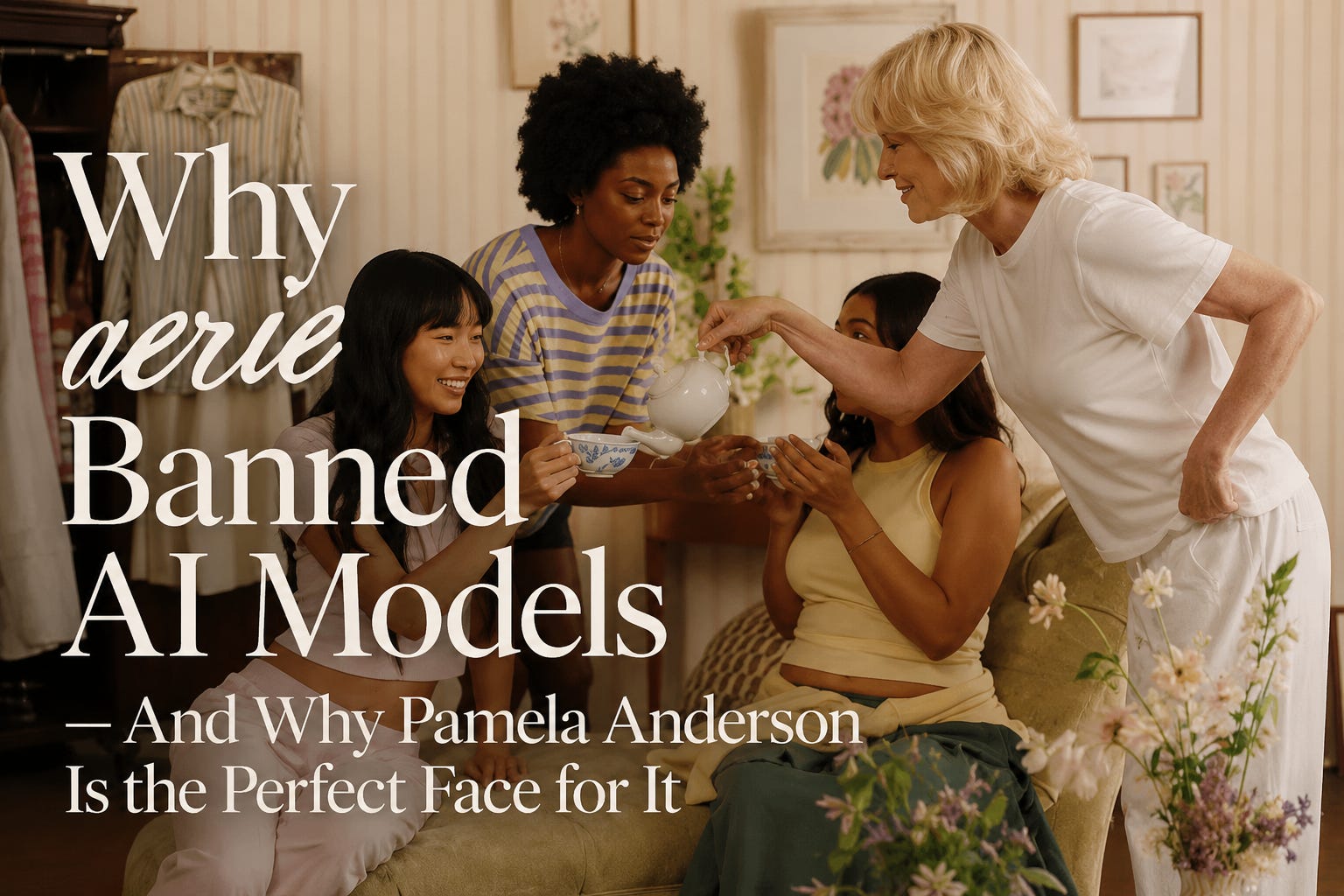
In late March, Aerie dropped a campaign with Pamela Anderson that opens with her voice prompting an AI model generator.
"Make her happier." "More joyful." "More natural."
She keeps prompting, and the faces keep coming back wrong — too plastic, too lifeless, too prompted. Frustrated, she finally says, "Make them feel real."
The artificial scene dissolves, and we're suddenly on a cozy Aerie set with actual humans. Anderson looks straight into the camera and delivers the line that doubles as the brand's entire strategy:
"You can't prompt this."
Then in the bottom corner of every asset — every social ad, every CTV spot, every still — Aerie stamps it: Shot by real people. Real people made this.
That's the campaign.
And here's the data the rest of the industry should be paying attention to: Aerie's Q4 2025 sales were up 23% year-over-year, and brand awareness jumped double digits in the same timeframe. While every other retailer was scrambling to figure out how to scale content with AI, Aerie was publicly committing to not using it — and the numbers are working.
The Decade-Long Brand Strategy Behind Aerie's Anti-AI Campaign
If you only watched the ad, you'd think this was a 30-second statement, but it's really the second chapter of a brand position Aerie planted over a decade ago.
In 2014, Aerie launched #AerieReal — the campaign where they stopped retouching their models. No Photoshop, no airbrushing, stretch marks and cellulite and scars all left in. Critics called it a marketing stunt, but Aerie held their position for 12 years and built an entire brand identity around it.
Now they're applying that same principle to the next obvious threat: AI-generated bodies.
Here's why their positioning is so strong: they didn’t just announce they’re "real" when it became convenient—they’ve been using this marketing message for the last ten years. And the consistency isn’t just building trust, its build profits.
Let me break it down.
1. Signal trust by publicly rejecting something.
Trust isn't built with statements like "we care about you." Trust gets built when a brand publicly turns down money or efficiency in service of a value they've claimed.
Aerie publicly closed the door on the cheapest, fastest content production tool in marketing history, which means they're choosing to absorb a cost their competitors aren't, and their customers know it. When you reject something visibly — when you say "we won't use AI" or "we won't run sales" or "we won't pay influencers we don't actually use" — you do something the best ad copy can't do. You demonstrate to your audience that you would rather lose the margin than lose them.
That's the strongest trust signal a brand can send, and it's why this campaign is going to compound over the next 18 months in ways most observers are underestimating. Every time a competitor rolls out an AI-generated ad, Aerie's no-AI commitment gets stronger by contrast. They're not just running a campaign — they're building a position that gets more valuable every time someone else makes the opposite choice.
2. Your competitive edge in a saturated market is what you publicly refuse to do.
Every brand is racing to do more with AI — more content, more variations, more personalization, more speed. Aerie just said no, and not because they can't or don't have the tools. They said no because they understand something most of their competitors don't: in a market where everyone is doing the same thing, your edge is the thing you won't do.
I'll be the first to tell you AI isn't the enemy. I've built plenty of marketing campaigns on the back of AI - and there’s hardly a day I don’t use it somewhere in my business. And this is exactly why I think the brands making strategic decisions about where to use it (and where not to) are going to outperform the brands using it everywhere.
Patagonia says no to fast fashion.
Trader Joe's says no to traditional advertising.
And now Aerie is saying no to AI-generated humans.
Each one of those refusals is a brand identity people pay a premium for.
What does your brand say no to — out loud, in public, on record?
(Because if you can't answer that question, your competitors can't tell you apart from anyone else in your category).
3. Scarcity is now the strategy. "Real" is becoming rare.
Here's what's happening underneath the surface: AI is making content infinite, which means content is becoming worth less — not worthless, but worth less than it used to be — and the supply curve is exploding in every direction.
What's getting scarce is human attention, human craft, and human presence — the proof that a real person made the thing you're holding, watching, or wearing. Aerie is selling the presence of humans in a market that's making humans optional, and in a world where AI-generated everything is racing toward infinity, "made by humans" is about to become the most valuable label on the shelf. Aerie wants to own that label before the rest of the market realizes it's worth owning.
The takeaway here is to start naming what's irreplaceably human about how you build and market your business — your point of view, your handcrafted client experience, your founder's voice, your in-person events, the way your team actually shows up for the people you serve — and putting that on the front of your storefront. Once "human" becomes a category descriptor in our industry (and it will, fast), the brands who claimed it first will be the brands the audience trusts the most.
4. A decade of brand consistency compounds — until the market catches up to you.
Aerie didn't start saying "real" last month — they started in 2014. For most of that decade, no one outside their core customer base really cared, but they kept saying it anyway. Then AI happened, and suddenly the word "real" became the most valuable word in their vocabulary, because the rest of the market had abandoned it.
You don't get to pick a brand value when it becomes profitable. You pick it when it isn't, and you hold the line for years, and then one day the market shifts and your position becomes the only position. The thing you've been saying the whole time becomes the thing everyone suddenly needs.
The compound effect of brand consistency looks like nothing for years, and then it looks like a 23% sales jump in a single quarter.
What's the line you're holding right now that the market hasn't rewarded yet?
5. Pick a face that proves the position.
This is the part of the Aerie playbook I think is genuinely brilliant. Pamela Anderson is doing more than endorsing the brand — she's embodying the brand position itself.
This is a woman whose narrative was hijacked by tabloids, by men, and by the entertainment industry for thirty years. In the last few years, she's reclaimed it — going makeup-free in public, telling her own story on her own terms, refusing to perform the image other people built for her. Aerie's CMO said it plainly: "It doesn't get more real than Pamela — she embodies real and what it means to reclaim yourself."
The campaign works because it isn't a typical celebrity-and-brand pairing. It's two entities making the same argument from different angles. Pamela reclaimed her image from the entertainment industry, and Aerie is reclaiming their imagery from AI. It's the same fight on a different battlefield, and the audience feels the alignment even when they can't articulate why.
Most founders pick spokespeople based on follower count. The smart ones pick spokespeople whose lived story is identical to the brand's strategic position.
Who in your industry's orbit is living your brand value? They are an aligned brand partner.
The bigger picture
Aerie isn't the last brand that will do this — they're just the first I've seen publicly draw the line. There will be more.
The brands that conqueror the next decade are going to look like one of two things:
AI-maximalist — scaling content, personalization, and creative output with AI to levels the industry has never seen.
Human-first — publicly committing to no AI in some core part of their brand experience, and selling the scarcity of that commitment.
The middle is going to disappear. The middle is where you use AI without making a claim either way, and it's the most crowded, undifferentiated position in the market.
The brands sitting in the middle aren't going to die from AI — they're going to die because no one remembered them.
Aerie picked a side, put it in writing, made Pamela Anderson the spokesperson, and watched their sales lift 23% in a single quarter. This is what brand strategy looks like when a company holds onto values that aren't just printed on their About page but are the kind they're willing to put in lights and defend in public.
To staying real, even when it costs you,
Ashley
P.S. Hit reply and tell me: what's one thing your brand publicly refuses to do? If you don't have an answer yet — that's your homework this week.
If you are interested in working together or hiring me as your Fractional CMO, click here.
TL;DR Summary — Aerie’s Anti-AI Brand Bet With Pamela Anderson
The result: Aerie’s Q4 2025 sales were up 23% year-over-year alongside a double-digit jump in brand awareness — one of the strongest performances in the women’s intimates category for the quarter.
The strategy: Aerie formalized a “100% Aerie Real” pledge in October 2025, publicly committing to never using AI-generated bodies or AI-generated people in its marketing — building on the original 2014 #AerieReal campaign that stopped retouching their models.
The proof it worked: A double-digit brand awareness lift, 23% sales growth in Q4, and a viral campaign tagline (”You can’t prompt this”) that’s now being cited across Adweek, Ad Age, Marketing Brew, Fortune, and Vogue Business.
The campaign play: Cast Pamela Anderson — a woman whose own public story is about reclaiming her image — as the face of the no-AI campaign. Open with her frustrated by AI prompts that won’t deliver “real,” then reveal a human Aerie set. Stamp “Shot by real people. Real people made this.” on every asset across paid social and CTV.
The lesson for founders: Your competitive edge in a saturated market is what you publicly refuse to do. Hold a brand value before the market rewards it, choose spokespeople whose lived story embodies the position, and treat refusal as the strongest trust signal you can send.
The one question to ask yourself: What does your brand publicly refuse to do — out loud, in public, on record? If you can’t answer that, your competitors can’t tell you apart from anyone else in your category.