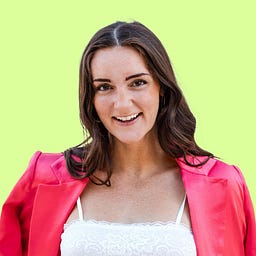
I was 31 weeks pregnant, standing in my kitchen in Utah, surrounded by half-packed boxes — having what I'll generously call a "spirited discussion" with Jeremy about whether we could actually pack our $150 coffee maker in our bags to another country.
In three weeks, we were selling everything we owned, pulling Liam out of school, and moving our entire life to a beach town in Mexico — with no relocation package, no company transfer, no safety net beyond a business I was still duct-taping together between prenatal appointments and client Zoom calls.
My mother had questions, my in-laws had concerns, and my doctor had facial expressions (apparently giving birth abroad wasn’t his top recommendation).
But when you're about to blow up your life on purpose — the scary part isn't leaving. It's the morning after you arrive.
It was being jet-lagged, enormously pregnant, and standing in a kitchen with no coffee, realizing I now had to actually build the thing I said I wanted (and promised I could create).
We weren't going on vacation — we were switching roles and starting a new life from scratch. And the weight of giving birth and becoming the family's new breadwinner left me feeling a little excited, a little proud, and scared that I might fall short.
What I didn't expect was how many people would say to me: "I can't believe you're actually doing it."
Actually.
The wildest part is that during this season, people started showing up — following along, DMing me, asking why and how we did it.
Not because I had some master marketing plan to sell them something. I'm not a travel influencer with a relocation guide. But the life we were building — publicly, imperfectly, in real time — was something people wanted to be part of.
I didn't have language for what was happening until recently. And then I started noticing the biggest companies on the planet doing the exact same thing — just at a completely different scale.
They weren't selling. They were building worlds.
In November 2025, Netflix gutted a 100,000-square-foot Lord & Taylor inside a Philadelphia mall, hung a giant red envelope over the entrance, and basically said: "Welcome to our house."
Netflix House. You walk through the envelope (a nod to the DVD-by-mail era, which — if you remember that, congratulations, we're old) and suddenly you're standing on the Bridgerton set. Around the corner, the Squid Game staircase. There's a full restaurant, a 229-seat theater, VR experiences, mini-golf.
And the entrance? Free. No ticket. No subscription check. You just walk in.
Their CMO said something that made me set my phone down: "They've been inviting us into their homes for years. Now we're returning the favor."
Netflix — a company that lives on your TV screen — decided that wasn't enough. They needed to build a place you could physically walk into. Dallas opened a month later. Las Vegas is coming in 2027.
And every person who walks in and posts from the Bridgerton throne on Instagram? That's marketing money can't buy.
When I read about Netflix House, I thought about us standing outside the airport with nine suitcases — and people following the story every single frame. Not because I was selling anything, but because they wanted to see what would happen. Would it work? What is Mexico actually like? Is it safe? Are they crazy?
Netflix built a physical place people wanted to experience. I accidentally created a story people wanted to be a part of.
But Netflix isn’t the only ones.
Kit — formerly ConvertKit, the email marketing platform — built five professional podcast studios in downtown Boise.
I need you to read that again. An email company built recording studios.
Beautiful rooms, teleprompters, professional acoustics, and each one themed after a Taylor Swift song — because apparently "Fortnight" is now both a Grammy-nominated track AND a podcasting room with floor-to-ceiling blue velvet panels.
Free for any paying Kit customer. Chicago location is open. New York coming in 2026.
Kit's entire product lives on a screen. There is absolutely zero operational reason for them to build physical studios. But when Kit asked what their community actually wanted — it wasn't a new set of email templates. It was a way to feel like a real professional creator.
And when a creator walks into that room and records their first episode in a space that feels like it was designed for them — they stop being a customer on a billing cycle. They become a Kit creator. That's an identity shift, not a transaction. And identities don't cancel their subscriptions.
I realized that's exactly what happened to me. I'd gone from someone who talked about building a different life to someone who actually lived it — and the DMs I kept getting during our move proved it. They weren't "how much do you charge?" They were "people talk about doing this all the time, but nobody actually does it — and you did." That's not a customer response. That's an identity response — and people wanted to be near it.
And then there's Dick's Sporting Goods, which — I know, I know, not exactly the brand you expect in a "visionary marketing" conversation — but hear me out.
Dick's started building 100,000+ square-foot experiential megastores called "House of Sport" with rock climbing walls, batting cages, golf simulators, outdoor turf fields, running tracks — and at some locations, they convert the entire outdoor field into an ice rink in the winter.
The turf fields became so popular that local communities basically adopted them. Birthday parties. Youth leagues. Families showing up on Saturday mornings to hang out — at a Dick's Sporting Goods.
(If you told me five years ago that parents would voluntarily spend their weekends at a sporting goods store, I would've asked what they were putting in the Gatorade.)
When Nike's leadership team visited, they called it "the best expression of sport anywhere in the world." Dick's went from 12 locations to 26 in a year, targeting 75–100 by 2027.
Their SVP said something that I think is the best one-liner in this entire article: "You come to Dick's to buy a soccer ball — so let's give you a venue to try it out."
Not a coupon. Not a retargeting ad for the soccer ball you looked at last Tuesday. A place to play.
Here's the pattern I can't unsee.
A streaming company built a theme park. An email platform built recording studios. A sporting goods store built a playground.
Three totally different industries. Not one of them asking for the sale at the door.
And it's not just these three — experiential marketing spend is up 10% year over year, and 85% of consumers say they're more likely to buy after a live brand experience. Business of Fashion is calling 2026 the year of "slow advertising" — the idea that brands are finally done screaming for attention and are starting to earn it by building things people actually want to show up for.
The brands winning right now aren't the loudest. They're the ones building something real — something you can experience beyond the cash register.
This is something I did before I even understood what I was doing.
I didn't move to Mexico with a marketing plan. I moved because I wanted to build a different life — and in the act of building it publicly and imperfectly, I created something other people wanted to follow and be a part of. Not because I had anything to sell, but because I had something to build — and people could feel that.
And that's the whole game. Not "how do I sell more?" but "how do I build something that people want to be a part of?"
And before you think this only works if you're Netflix or you're moving to another country — it doesn't.
It's the course creator who stops posting testimonial graphics and instead hosts a monthly live session where students workshop their biggest problem together — and suddenly the "community" section of the sales page writes itself.
It's the coach who builds a private podcast feed with behind-the-scenes strategy breakdowns for her clients — and those clients never leave because they feel like insiders, not customers.
It's the founder who throws one in-person dinner in her city for 15 of her best people — no pitch, no agenda — and every single one of them becomes a referral source for the next two years.
Because there's a gap between someone who bought your program and someone who sees themselves in what you're building — and that gap is where the retention lives.
Build a world sales can walk into.
(And if you're building it in Mexico — save the space in your bag and ditch the coffee maker.)
To building worlds worth belonging to,
Ashley 🌺
P.S. Just got back from SXSW in Austin and there were several founders creating their curated dinner experiences. While that might feel like a generic idea - what made this so good was how each founder created a different experience based on their brand (brunch vs dinner, outside vs inside, 15 people vs 100 - decide what you want to be known for and let people experience you!)